
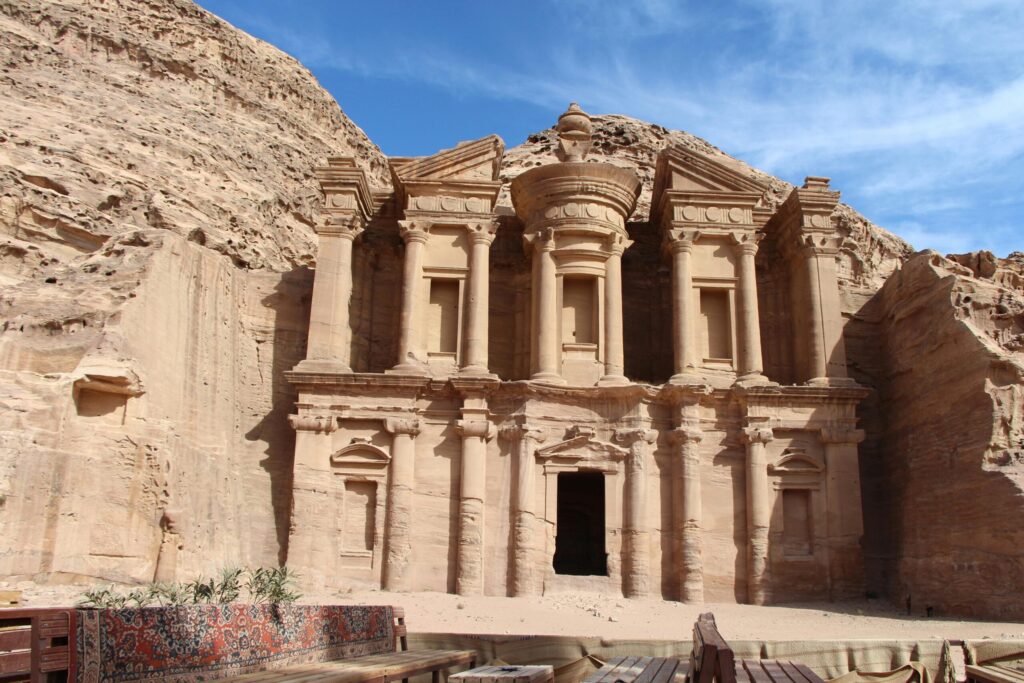
Jordan: Petra, Wadi Rum and the Nabataean Desert
Jordan sits at the northern end of the Nabataean trade route. AlUla was the southern capital. Petra was the northern one. The journey between them — across the Hejaz and into Wadi Rum — traces one of the oldest commercial corridors in the ancient world. For travellers combining Saudi Arabia and Jordan, this connection gives the whole journey a historical coherence that neither country provides alone.
Jordan is compact. Within five days, the terrain moves from the Roman ruins of Amman to the rose-red canyons of Petra to the vast desert silence of Wadi Rum to the Red Sea coast at Aqaba. Each environment requires a different pace. Consequently, the strongest Jordan journeys resist the temptation to rush and instead commit to fewer places with more time in each.
Petra
The Siq is a 1.2-kilometre crack through the sandstone. The walls rise 80 metres on both sides. At the end, the Treasury appears — carved directly from the cliff face, 40 metres high. The scale is not visible in photographs. It must be encountered on foot, at dawn, before the groups arrive.
Petra has over 800 individual monuments. Most visitors see fewer than a dozen. The wider city — the colonnaded street, the royal tombs, the monastery at the top of 800 steps — rewards travellers who stay two nights and commit a full day to walking. Furthermore, the landscape beyond the central zone is almost empty. A guide who knows the trails changes the experience entirely.
Wadi Rum
Wadi Rum covers 720 square kilometres of protected desert. Sandstone and granite towers rise from the valley floor in formations that change colour through the day — pale at midday, deep red-orange at dusk. The desert is quieter than Petra. Additionally, it is more spatially disorienting — there are no roads in most of it, only tracks that require local guides.
T.E. Lawrence travelled through Wadi Rum in 1917. His description of it in Seven Pillars of Wisdom remains accurate. The landscape is essentially unchanged. Spending two nights in the desert — one for orientation, one for absorption — produces a very different experience from a single afternoon visit from Petra.
The Dead Sea
The Dead Sea sits 430 metres below sea level — the lowest exposed point on earth. The water is ten times saltier than the ocean. Nothing lives in it. The surrounding desert mountains descend sharply to the water’s edge. The light across the surface in the early morning is unlike anything elsewhere in the region. The Dead Sea is shrinking — losing roughly one metre of surface level each year. Visiting it now is visiting something in the process of disappearance.
Where to Stay in Jordan
Three properties cover Jordan’s strongest landscapes for serious travellers.
Sun City Camp sits in the heart of Wadi Rum — dome tents and bubble pods positioned directly under one of the darkest night skies in the Middle East. Mövenpick Resort Petra is the most convenient luxury property for the site — walking distance from the Siq entrance and the least disruptive base for early morning access. Kempinski Hotel Ishtar occupies one of the strongest Dead Sea positions — terraced gardens descending to the water and the established luxury standard that the Dead Sea circuit demands.
When to Travel
March through May and September through November are the strongest months. Temperatures are comfortable. The light is good. Summer brings heat that makes Petra and Wadi Rum difficult between midday and late afternoon. Winter is cold at elevation — Petra sits at 900 metres and can be genuinely cold in January. However, winter crowds are minimal and the light is exceptional. Furthermore, combining Jordan with Saudi Arabia works best in the October to April window when both countries are at their most accessible.
Combining Jordan with Other Arabia Destinations
Jordan and Saudi Arabia share the Nabataean route. Combining Petra and Wadi Rum with AlUla and the Saudi Red Sea creates one of the most coherent archaeological and desert journeys available in the region. Additionally, Oman adds the mountain and coastal dimension that completes a comprehensive Arabian Peninsula circuit.
For Saudi Arabia: Saudi Arabia
For AlUla: AlUla
For the full Arabian Peninsula: Arabia by Oloi Shorua
If you are considering Jordan as part of a private Arabian journey, we would be pleased to begin with a conversation.
Visit Jordan — visitjordan.com