Wadi Rum: Desert Camps and the Sandstone Wilderness
Wadi Rum covers 720 square kilometres of protected desert in southern Jordan. UNESCO inscribed it as a World Heritage Site in 2011 — both for its geology and its archaeology. Nabataean inscriptions, rock art and ancient camel routes survive in the canyon walls alongside sandstone and granite formations that rise 300 metres from the valley floor. T.E. Lawrence passed through here in 1917. His description in Seven Pillars of Wisdom remains the most accurate account of what the landscape produces in a person who pays attention to it.
The light here is red. Not the pale gold of the Empty Quarter — red and orange, from iron oxide in the sandstone. It intensifies at dusk. Furthermore, the night sky at Wadi Rum has almost no light pollution. Two nights in the desert — the first for orientation, the second for absorption — produce a quality of experience that a single visit cannot.
The Landscape
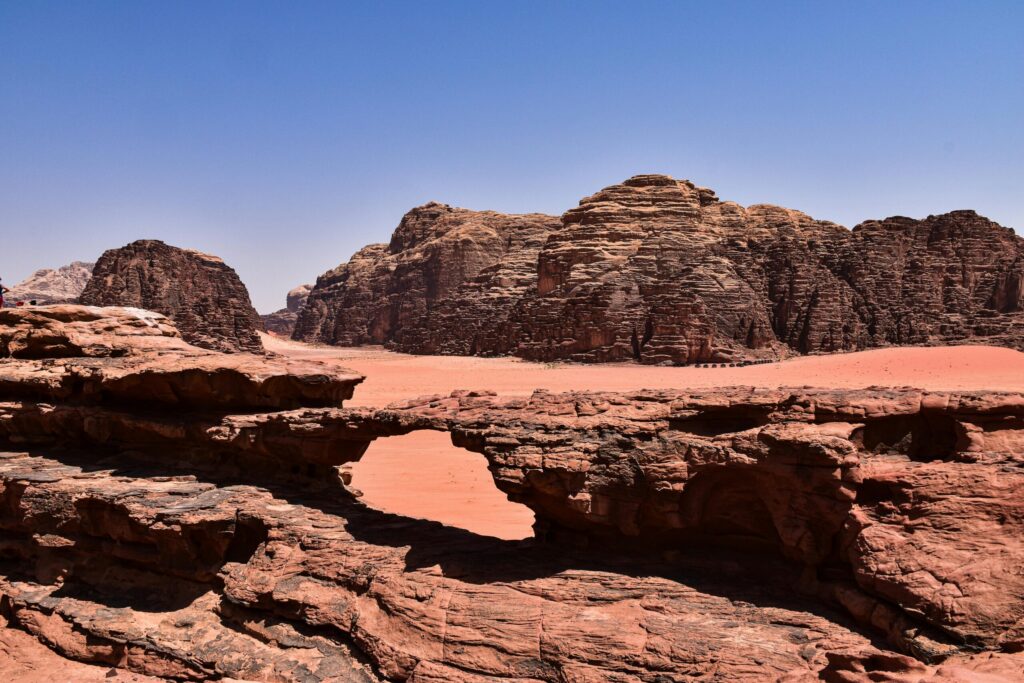
The desert floor is not uniform. Red sand dunes alternate with flat gravel plains. Granite massifs — darker and harder than the surrounding sandstone — rise from the valley in isolated formations. The Burdah Rock Bridge spans a natural arch high above the desert floor. The Khazali Canyon holds Nabataean inscriptions carved into the cliff face at eye level. These are not reconstructed — they were carved two thousand years ago by people moving along the same trade route that AlUla anchors further south.
Movement through Wadi Rum is by 4WD with local Bedouin drivers who know the terrain without GPS. The routes change with season and the driver’s judgement. Consequently, no two days in the desert are identical.
Where to Stay
Wadi Rum’s camp circuit has developed quickly. The strongest properties sit within the protected area itself — positioned away from the main visitor hub and accessible only by desert track.
Sun City Camp is among the most established luxury options — dome tents positioned directly under one of the darkest night skies in the Middle East, with private outdoor areas and a strong sense of desert immersion. Wadi Rum Night Luxury Camp offers a more contemporary approach — bubble tents and mirror cube structures that dissolve the boundary between the interior and the night sky above. Memories Aicha Luxury Camp takes a quieter position within the desert — fewer units, stronger attention to guiding and a more intimate atmosphere than the larger camps.
The Nabataean Connection
Wadi Rum and AlUla in Saudi Arabia share the same trade route history. The Nabataeans moved between them — frankincense and spice northward, goods from the Mediterranean south. The inscriptions in the Khazali Canyon are written in the same Nabataean script as those at Hegra. Travelling both sites within a single journey gives that connection physical reality. The route between them still exists as a landscape — the Hejaz, the desert, the Gulf of Aqaba, and then Jordan beyond.
When to Travel
October through April is the correct window. Days are warm. Nights are cold — pack for temperatures below ten degrees in December and January. The cold is part of the experience. Summer brings heat that makes overland desert travel uncomfortable from mid-morning. Furthermore, the spring months of March and April bring occasional wildflowers to the desert floor — a surprising and brief transformation of the landscape.
Combining Wadi Rum with Other Destinations
Wadi Rum connects directly to Petra — two hours north by road. Aqaba and the Red Sea coast are forty minutes south. Combining all three creates the strongest southern Jordan circuit. Additionally, the Saudi border crossing at Durra gives access to AlUla and the Hejaz for travellers who want to follow the Nabataean route across both countries.
For Jordan: Jordan
For AlUla: AlUla
For the full Arabian Peninsula: Arabia by Oloi Shorua
If you are considering Wadi Rum as part of a private Arabian journey, we would be pleased to begin with a conversation.
Visit Jordan — visitjordan.com