The Saudi Red Sea: Private Coastal and Island Journeys
Saudi Arabia’s western coastline extends for over two thousand kilometres along the Red Sea. The northern section — between Tabuk and Yanbu — contains coral reef systems of global scientific significance. These reefs are among the most resilient on earth. They demonstrate unusual tolerance for elevated water temperatures at a moment when bleaching events are destroying reef systems worldwide. Scientists consequently study them actively for what they might reveal about the future of coral conservation globally.
Developers are currently building infrastructure along this coast that will eventually make it broadly accessible. However, that infrastructure does not yet exist at scale. The marine environment remains intact. Very few visitors currently access the islands that will eventually anchor resort development. Consequently, the coastal silence of the northern Red Sea connects directly to this specific moment in the region’s development.
The Geography
The Red Sea is defined by contrast at every scale. Desert terrain meets coral coastline. Remote island chains emerge from open water while the Hejaz mountain range rises inland. In the north, the NEOM development zone occupies the Gulf of Aqaba coastline. Here, Saudi Arabia, Jordan and Egypt meet at one of the most geographically dramatic junctions in the Arabian Peninsula. Further south, the Red Sea project archipelago forms the heart of the region’s emerging luxury circuit. Ummahat Al Shaykh, Shurayah and a chain of smaller islands sit at its centre.
The movement from AlUla to the Red Sea coast is itself one of the strongest geographical transitions in Arabia. Sandstone valley gives way to volcanic terrain, then to mountain escarpment, then to sea. That progression — undertaken over land — produces a depth of regional understanding that resort-only travel cannot replicate.
The Marine Environment
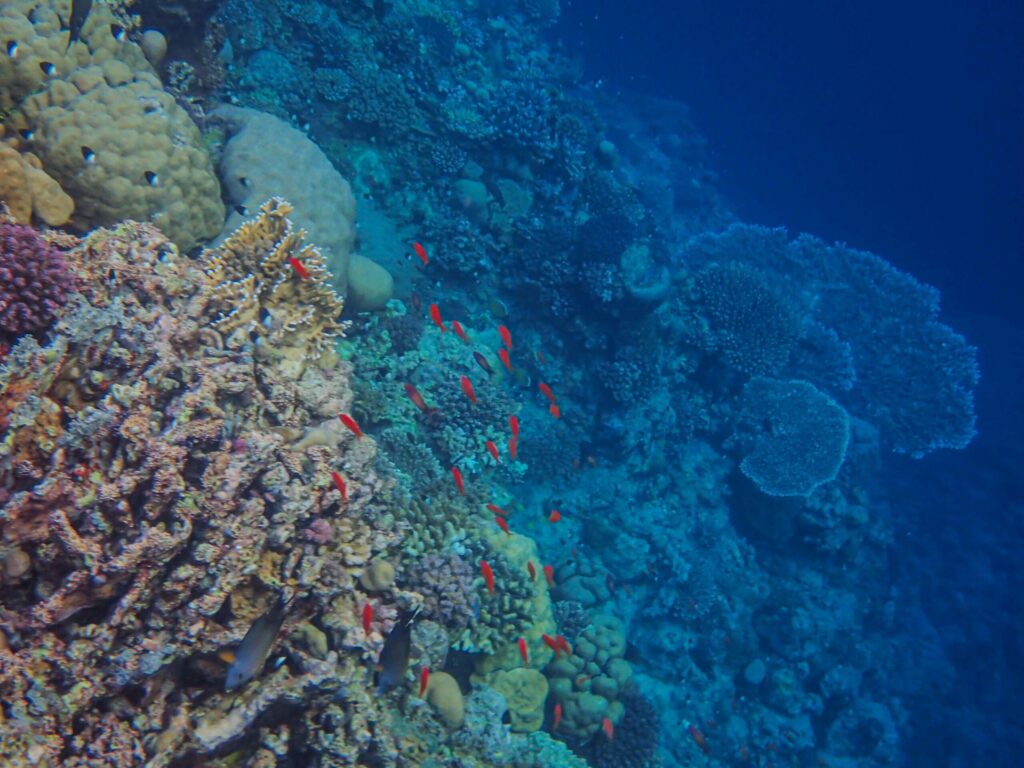
Few divers have explored the Saudi Red Sea compared with the Egyptian and Jordanian shores of the same body of water. In fact, water visibility regularly exceeds thirty metres. The coral cover is exceptional — dense formations of table coral, brain coral and soft coral. These support an extraordinary diversity of fish, ray and shark species. Additionally, Red Sea Global manages the protected marine areas across the project archipelago with conservation as an explicit primary objective rather than an afterthought.
For serious divers, the Saudi Red Sea represents one of the most significant untouched dive destinations remaining on the planet. Moreover, for those who simply want to be near the water — snorkelling from a private island, moving between anchorages by boat — the experience is defined by space and silence. The more developed northern shores of the Red Sea cannot provide either.
Where to Stay on the Red Sea
The hospitality circuit on the Saudi Red Sea is small, deliberate and moving toward landscape integration rather than scale. Three properties currently define the strongest options for serious travellers.
Nujuma, a Ritz-Carlton Reserve occupies Ummahat Al Shaykh island in the Red Sea project archipelago. It is consequently the only Ritz-Carlton Reserve on the Arabian Peninsula. Shebara takes a different approach — an eco-conscious overwater lodge on a private island with one of the most distinctive architectural concepts in the region. Six Senses Southern Dunes moves the Red Sea experience inland. This wellness-focused property sits within the dune landscape behind the coast, combining Six Senses’ wellbeing philosophy with an unusual desert environment.
When to Travel
The Red Sea coast is accessible year-round. The optimal window for diving and overland travel is, however, October through May. Water temperatures stay comfortable throughout the year. The Red Sea’s enclosed geography keeps it warmer in winter than equivalent latitudes elsewhere. Summer brings significant heat onshore that makes overland movement between the coast and inland destinations difficult. Therefore, for journeys combining the Red Sea with AlUla, October through April offers the strongest conditions for both environments simultaneously.
Combining the Red Sea with Other Arabia Destinations
The Red Sea combines most naturally with AlUla. The overland journey between them is one of the defining geographical progressions in Saudi Arabia. Additionally, Diriyah and Riyadh give the journey historical depth. Jordan across the Gulf of Aqaba extends the circuit northward into Petra and Wadi Rum territory. For travellers wanting to understand the full range of the Arabian Peninsula’s geography, the Red Sea is where desert meets sea. That meeting point is unlike anything else in the region.
For the wider Saudi Arabia journey: Saudi Arabia
For AlUla: AlUla
For the full Arabian Peninsula: Arabia by Oloi Shorua
If you are considering the Saudi Red Sea as part of a private Arabian journey, we would be pleased to begin with a conversation.
Red Sea Global — redseaglobal.com
Saudi Tourism — visitsaudi.com