
Arabian Journeys Petra
Petra sits at the heart of southern Jordan’s desert landscape. It holds one of the most extraordinary archaeological environments in the Middle East. The ancient Nabataean city reveals itself gradually through narrow canyon passageways and monumental carved facades. Changing desert light shifts across the surrounding mountains throughout the day. Consequently, no two visits to Petra produce exactly the same experience.
For travellers moving through Jordan and the wider Arabian Peninsula, Petra often becomes more than an archaeological destination. The silence of the surrounding desert shapes the experience. So does the scale of the terrain and the quality of the light at different hours. Furthermore, the site’s historical depth connects directly to the wider Nabataean story that runs from Wadi Rum to AlUla in Saudi Arabia.
At Oloi Shorua, we approach Petra through pacing, landscape and historical continuity. Every journey shapes around season, movement and the natural rhythm of travel through southern Jordan rather than fixed itineraries.
Understanding Petra Through Landscape
Petra reveals itself through transition and scale. The journey into the ancient city begins in narrow canyon corridors. Sandstone walls rise high above the path. They open unexpectedly into monumental facades and wider desert terrain beyond. Furthermore, Petra’s strongest impact comes not only from the structures themselves. The surrounding geography shapes the entire atmosphere of the region. Consequently, journeys through Petra work best when approached slowly and with enough time for the landscape to unfold naturally.
The Siq and the Treasury
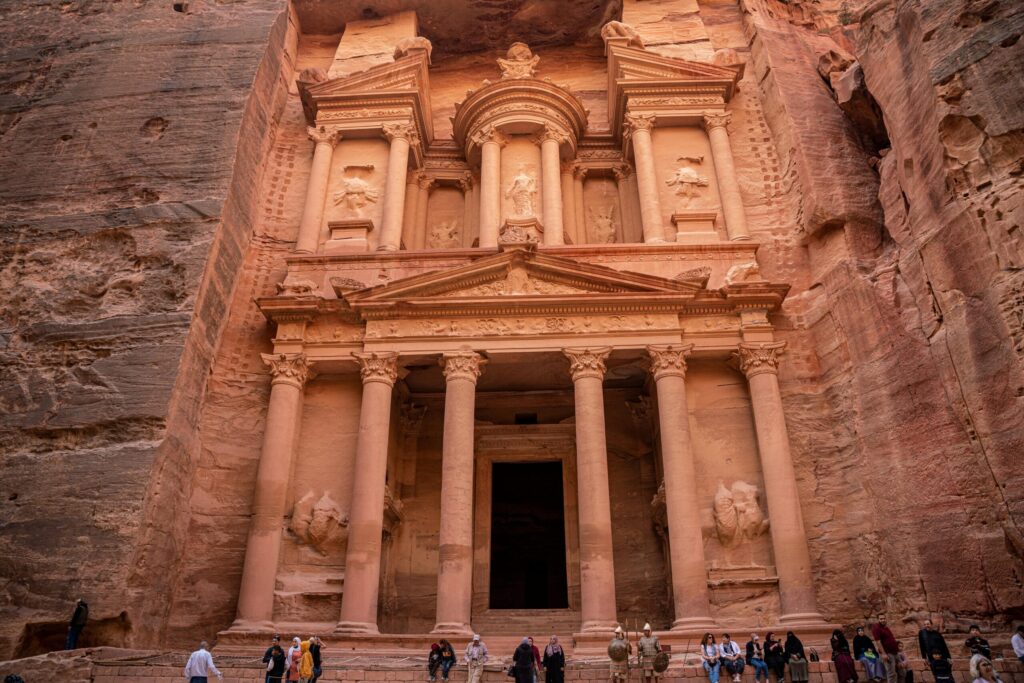
The Siq forms one of the most dramatic entrances in the ancient world. Narrow sandstone passageways wind through the canyon before revealing the Treasury. The light shifts as you move. Distances feel compressed and then suddenly expansive as the site opens beyond the gorge. Moreover, the movement through the Siq becomes central to the emotional rhythm of Petra itself. For many travellers, this gradual transition between canyon and monument remains the defining experience of any Arabian Peninsula journey.
Nabataean Trade Routes
Historically, Petra stood at the centre of ancient trade networks. It connected Arabia, the Levant and wider commercial routes across the region. The city’s architecture still reflects this long history of movement and exchange. Additionally, its position within the desert landscape makes the relationship between trade, terrain and culture physically legible in a way that few archaeological sites achieve. As a result, Petra provides important historical context within wider journeys across Jordan and the Arabian Peninsula.
Landscape and Desert Atmosphere
Beyond the main archaeological zone, the wider landscape surrounding Petra remains central to the experience. Sandstone mountains and elevated viewpoints frame the site from above. Open desert terrain creates an atmosphere shaped by silence, geology and light. Early mornings reveal the strongest sense of scale and stillness. Furthermore, quieter evening hours shift the quality of light on the rock faces in ways that midday visits cannot replicate. For travellers seeking a slower approach, the landscape itself becomes as important as the archaeological structures.
The Future of Heritage Travel in Arabia
Across the Arabian Peninsula, travellers increasingly seek journeys that combine historical depth with landscape and slower pacing. Petra reflects this shift naturally. Its combination of archaeology, environmental scale and desert atmosphere places it beyond landmark tourism. Moreover, the site’s continuity with the wider Nabataean world — from Wadi Rum to AlUla — gives it a geographical significance that grows as Saudi Arabia opens further. Therefore, Petra remains one of the most important anchors in any serious Arabian Peninsula journey.
How We Design Journeys Through Petra
Every journey begins with a conversation. From there, we shape how movement through Petra should unfold — when to travel, how long to remain and how the archaeology should connect to the wider landscape. We design every journey individually around season, pace, terrain and personal interests. Some travellers focus entirely on the archaeology. Others combine Petra with Wadi Rum, Aqaba and wider Arabian Peninsula destinations. In all cases, our role is to create continuity and rhythm throughout the experience. Additionally, we allow the landscape itself to define the pace rather than imposing a fixed schedule upon it.
Journeys Across Petra
- Archaeological and heritage-led journeys
- Landscape and photography-focused travel
- Slower desert exploration
- Combined archaeology and coastline journeys
- Historical trade-route journeys
- Multi-region Jordan travel
- Wider Arabian Peninsula travel
These are not predefined routes. Instead, they act as starting points refined individually through discussion and planning.
Petra Within Jordan
Petra combines naturally with wider journeys across southern Jordan. The movement between Petra, Wadi Rum and the Dead Sea creates broader regional circuits. Each transition shifts the terrain and the atmosphere. Additionally, combining Petra with Aqaba adds a coastal dimension to what is otherwise a desert and archaeology journey. Over time, these combinations allow travellers to experience multiple dimensions of Jordan through shifting landscape, historical continuity and environmental contrast.
Many journeys combine Petra with:
- Jordan
- Wadi Rum
- Aqaba
- Dead Sea
Begin Your Journey Through Petra
Our work across Petra continues to develop through regional partnerships, specialist operators and guiding teams across southern Jordan. If you are considering a journey through Petra and prefer a quieter, more informed and landscape-led approach to travel, we would be pleased to begin with a conversation.
Jordan — Visit Jordan
Petra — Explore Petra