Saudi Arabia Travel: Private Journeys Across the Kingdom
Saudi Arabia is the fifth largest country on earth. In fact, it covers 2.15 million square kilometres — an area larger than Western Europe. Within that space, the geographical variation is extreme. The sandstone archaeology of AlUla sits in the northwest. Aseer’s monsoon-influenced highlands rise in the southwest. The coral ecosystems of the Red Sea extend along the western coast. Further south and east, the immense sand desert of the Empty Quarter dominates the interior. Each region demands a different pace and a different quality of attention.
The tourist visa opened in 2019. Saudi Arabia is consequently early in its evolution as an international travel destination. Indeed, landscapes here carry no over-interpretation yet. The archaeology holds the weight of genuine obscurity only recently lifted. Coastline remains largely undeveloped. The window for experiencing the Kingdom in this condition is open — and it will not remain open indefinitely.
At Oloi Shorua, we approach Saudi Arabia through pacing, geography and continuity rather than fixed itineraries. Every journey is designed individually around season, landscape and the natural rhythm of movement across the Kingdom. The country cannot be understood quickly. In fact, it requires time — and it rewards that time generously.
AlUla and the Nabataean World
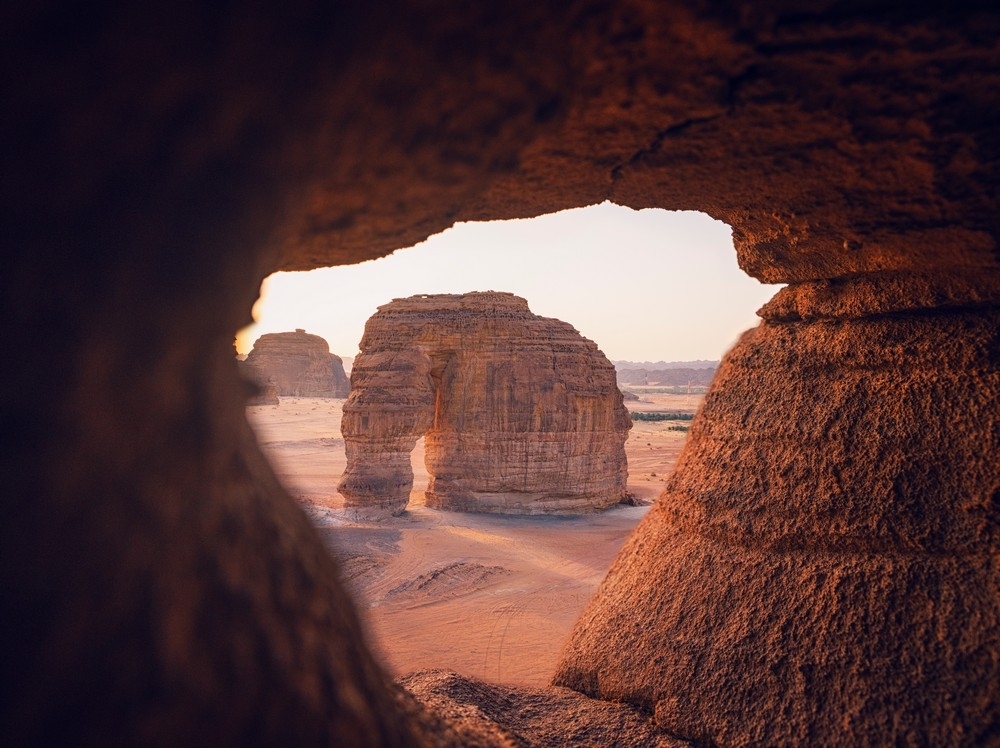
AlUla is where most serious international travellers begin their understanding of Saudi Arabia — and often where they discover how much they had underestimated the country. The sandstone valleys of north-western Saudi Arabia contain Hegra, the Nabataean civilisation’s second city after Petra. Over one hundred monumental rock-cut tombs line the cliffs. Inscriptions remain legible after two thousand years. Furthermore, this is a UNESCO World Heritage Site that most of the world has not yet heard of.
The landscape surrounding the tombs is as powerful as the archaeology within it. Narrow sandstone corridors, isolated rock towers and desert valleys shaped by millions of years of wind and water create an environment where geology and human history are inseparable. AlUla consequently rewards early mornings on foot, slower movement through the formations and enough time for the changing light to reveal the landscape differently across the course of a day.
The strongest AlUla journeys build around three to four days minimum. The site repays every additional hour spent within it.
The Red Sea Coast
Saudi Arabia’s western coastline extends for over two thousand kilometres. The northern reefs — between Tabuk and Yanbu — contain coral ecosystems of global scientific significance. They are among the most resilient coral systems on earth, demonstrating unusual tolerance for elevated temperatures at a moment when bleaching events are destroying reefs elsewhere. Scientists therefore actively study these reefs for what they might tell us about the future of coral conservation globally.
The infrastructure currently under construction along this coast will eventually make it broadly accessible. At present, however, that infrastructure does not yet exist at scale. The marine environment remains intact. Very few visitors currently access the islands that will eventually anchor resort development. As a result, the coastal silence that characterises the northern Red Sea today connects directly to this specific moment in the region’s development.
The Red Sea also changes the logic of a Saudi journey. Moving west from AlUla toward the coast — sandstone valley to volcanic terrain to mountain escarpment to sea — creates one of the strongest geographical progressions available anywhere in Arabia.
The Empty Quarter
The Rub’ al Khali — the Empty Quarter — is the largest continuous sand desert on earth. At 650,000 square kilometres, it extends across Saudi Arabia into the UAE, Oman and Yemen. Words cannot adequately describe the scale. You must experience it to understand it.
Roads become isolated. Distances feel abstract. The silence is total in a way that urban environments make difficult to imagine. There are no reference points against which to measure direction or distance. The landscape therefore reduces the traveller to a correct sense of proportion — a rare and genuinely valuable experience in modern travel.
Wilfred Thesiger crossed the Empty Quarter twice in the 1940s with Bedu companions. His account remains the most honest writing about this landscape that exists. Reading it before travelling here changes what you see when you arrive. Moreover, moving through the Empty Quarter with proper logistical support — carefully, at the right time of year — is one of the most demanding and most rewarding journeys available in Arabia.
The Aseer Highlands
Aseer is the Saudi Arabia that almost nobody visits. Its south-western highlands receive monsoon moisture from the Indian Ocean. Temperatures at elevation stay cool enough that the region has historically served as a summer retreat for Saudi families escaping the interior heat. Consequently, the landscape is terraced, agricultural and green — visually unlike anything else in the Kingdom.
The architecture of Aseer belongs to its own tradition — painted mud-brick towers, layered stone construction and a visual identity with no equivalent elsewhere in Arabia. Wildlife here carries its own significance: the Arabian leopard, critically endangered with fewer than two hundred individuals remaining in the wild, holds its primary Saudi habitat in these highlands. Additionally, hamadryas baboon troops move through the escarpment and are often visible from the road.
For travellers willing to move beyond the internationally recognised Saudi destinations, Aseer reveals a country within the country — ecologically richer, architecturally distinctive and almost entirely outside the current global travel conversation about the Kingdom.
Diriyah and Riyadh
Diriyah, on the western edge of Riyadh, is where the Saudi state began. The At-Turaif district — a UNESCO World Heritage Site — preserves the mud-brick architecture of the first Saudi capital. Founded in the fifteenth century, Ottoman forces destroyed it in 1818. The restoration now underway is consequently among the most ambitious heritage projects in the Islamic world. Understanding Diriyah before visiting AlUla or the Empty Quarter therefore places everything else in a historical frame that makes it more legible.
Riyadh rewards a day of careful attention. Its National Museum is one of the strongest history museums in the Gulf. The Murabba Palace complex carries a different scale of history from the towers nearby. Furthermore, the city’s relationship with its own past — the tension between preservation and development — is visible in the urban fabric in ways that tell you something important about where Saudi Arabia is heading.
For travellers combining Riyadh with wider Saudi journeys, the city provides historical and cultural context that the landscape alone cannot offer.
When to Travel Saudi Arabia
Saudi Arabia is a large country with significant climate variation across its regions. Timing therefore matters differently depending on where you are going.
For AlUla and the Red Sea coast, the optimal window is October through April. Temperatures are also comfortable for walking, diving and overland travel during this period. In particular, the light in AlUla during winter is exceptional — low, angled and rich in the early morning and late afternoon.
For the Empty Quarter, November through February offers the most manageable temperatures for extended desert travel. In particular, summer heat in the Rub’ al Khali is extreme and should not be underestimated.
For Aseer, the green season runs from approximately June through September when monsoon moisture transforms the highlands. Outside this window, the region is drier. However, the landscape and wildlife remain compelling year-round.
As a result, multi-region Saudi journeys require careful seasonal planning. We design each journey around the specific combination of destinations and the optimal conditions for each.
How We Design Saudi Arabia Journeys
Every journey begins with a conversation. We do not work from fixed itineraries. Saudi Arabia is too large and too varied for a single template to serve different travellers with different interests and different tolerances for pace.
Some travellers focus on AlUla and the Red Sea — a natural pairing that combines archaeology and marine environment within a single western Saudi journey. Others combine Diriyah and Riyadh with the Empty Quarter for a journey across the central and southern interior. Additionally, Aseer works well as a standalone destination or as the southern extension of a longer Kingdom journey.
Multi-country journeys combining Saudi Arabia with Oman, Jordan or the UAE are among our strongest regional offerings. The movement between Saudi desert and Omani mountain, or between AlUla and Petra, creates a depth of regional understanding that no single-country journey provides. Moreover, the overland connections between these countries give the journey a geographical coherence that flying between destinations removes entirely.
Our role throughout is to create continuity, rhythm and clarity — while allowing the landscape itself to define the pace of travel.
Further Reading
For a deeper understanding of Saudi Arabia as a travel destination, our Journal explores the Kingdom’s geography, archaeology and travel philosophy in detail.
Saudi Arabia Travel: What the Kingdom Actually Contains
The Arabian Deserts Are Not One Place
If you are considering journeys through Saudi Arabia and prefer a quieter, more informed and landscape-led approach to travel, we would be pleased to begin with a conversation.
Saudi Arabia — Visit Saudi
AlUla — Experience AlUla
Red Sea — Red Sea Global