Qasr Al Sarab Desert Resort by Anantara
Liwa Desert, Rub’ al Khali, Abu Dhabi — Anantara Hotels and Resorts
Qasr Al Sarab means Palace of the Mirage. The name is accurate. The resort rises from the Liwa Desert — the northern edge of the Rub’ al Khali, the largest uninterrupted sand desert on Earth — as a fortified Arabian structure surrounded by dunes that reach 150 metres in height. Nothing else is visible in any direction. Consequently, the sense of remoteness here is genuine rather than constructed. The Empty Quarter extends south across Saudi Arabia, Oman and Yemen for nearly a thousand kilometres from this point.
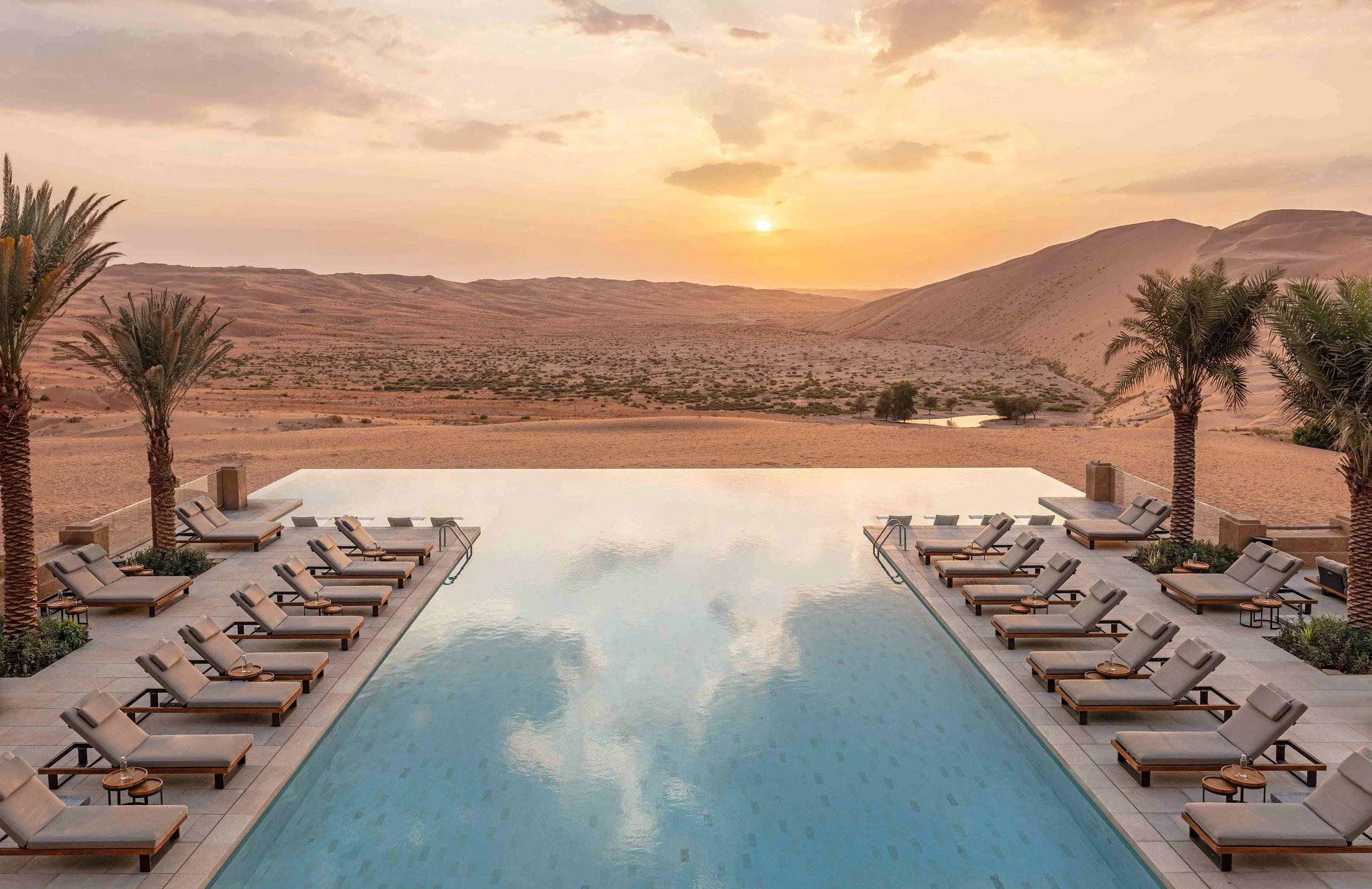
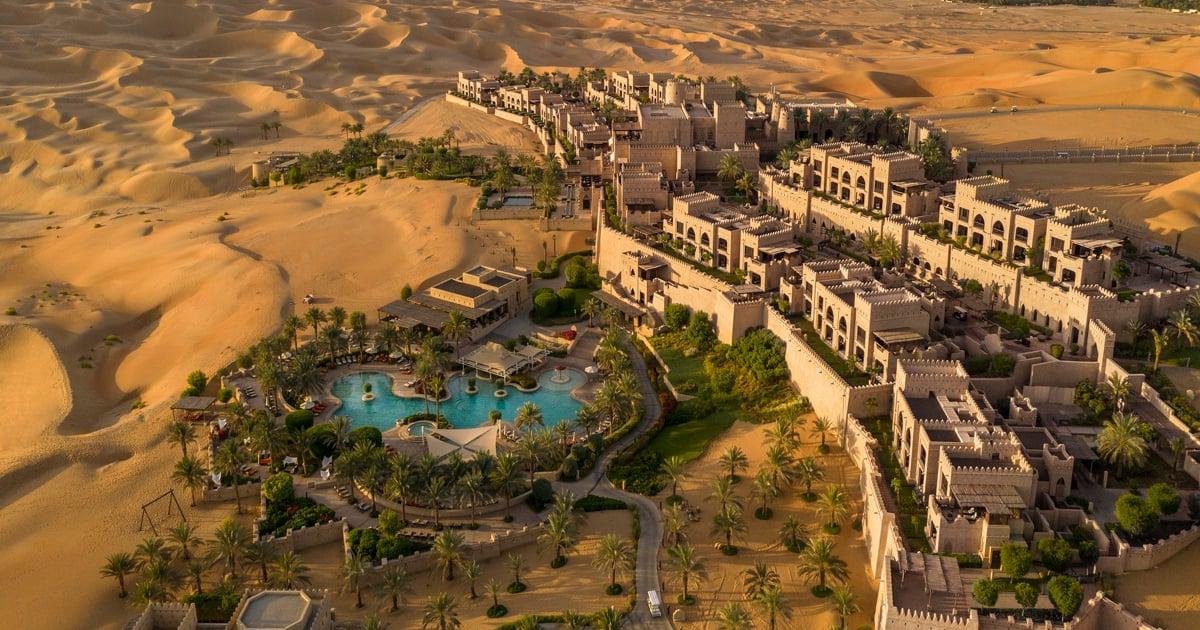
Anantara designed the property as a traditional Arabian qasr — fort-like walls, arched doorways, wind towers and courtyard gardens that reference the desert architecture of the region’s pre-modern past. The scale is considerable — 206 rooms, suites and villas across multiple wings. Furthermore, the infinity pool faces directly into the dune landscape, extending visually into the desert at the horizon line. Wilfred Thesiger crossed the Empty Quarter twice in the late 1940s and recorded the experience in Arabian Sands — one of the defining accounts of desert travel. Qasr Al Sarab sits at the edge of that same terrain.
The Empty Quarter
The Rub’ al Khali covers 650,000 square kilometres. It is the world’s largest continuous sand desert. The dunes around Qasr Al Sarab are among the tallest on the planet — some exceed 150 metres. Their colour shifts from pale gold at midday to deep copper and amber at dusk. At dawn, the light rakes across the dune faces at low angles and reveals a surface texture that the midday sun completely flattens. Additionally, the desert here carries no light pollution. The Milky Way is visible from the resort’s outdoor spaces on clear nights. Moreover, the silence of the Empty Quarter at night — no wind, no animals, no mechanical sound — is a physical experience that guests consistently identify as the most memorable aspect of the stay.
Accommodation
Qasr Al Sarab offers 206 rooms, suites and villas. All face either the dune landscape or the internal courtyard gardens. Standard rooms are generous in proportion with traditional Arabian furnishings and high ceilings. Suites add separate living areas and larger terraces for those wanting more space for multi-night stays. Pool villas provide the most complete privacy and the most direct dune connection. In addition, the Anantara brand delivers a service standard that combines consistent operational quality with local cultural detail — Arabic coffee and dates on arrival, regional craft elements in the interiors, and staff drawn largely from the UAE and wider Arabian Peninsula.
Activities
Qasr Al Sarab organises its activity programme entirely around the desert environment. Camel trekking moves through the dune terrain at dawn. Dune bashing in four-wheel drives covers the steeper dune faces at speed. Sandboarding runs down the largest ridges near the resort. Furthermore, falconry demonstrations use trained birds in the open desert with no enclosures or staged settings. Desert yoga and guided meditation sessions use the natural stillness of the Empty Quarter as their environment. Stargazing after dinner with the resort’s astronomy team provides context for the extraordinary sky overhead. As a result, the activity programme works equally well for guests seeking physical engagement with the landscape and those who simply want to understand where they are.
Dining
Three restaurants cover the range from all-day dining to atmospheric desert settings. Al Waha is the main restaurant — an open kitchen format with a wide menu of Arabic and international dishes. Ghadeer offers poolside dining throughout the day. Suhail, the signature restaurant, serves in a setting inspired by a Bedouin majlis with regional cuisine and a menu that changes with the season. Additionally, private desert dinners move guests beyond the resort perimeter into the dunes themselves — a candlelit table on the sand with the Empty Quarter in every direction and no other light visible. The Anantara Spa rounds out the in-resort offer with Arabian hammam treatments and a wellness programme appropriate to the desert environment.
When to Visit
October through April is the correct season for Qasr Al Sarab. Summer temperatures in the Liwa Desert regularly exceed fifty degrees and make outdoor activity impossible for most of the day. November through February produces the best dune conditions — cool mornings, warm afternoons and cold clear nights that reward the stargazing experience. Therefore, December and January offer the fullest version of what the resort provides. However, the shoulder months of October and March give strong conditions with lower rates and fewer visitors than the peak winter period.
Combining Qasr Al Sarab with Other Destinations
Qasr Al Sarab works as two nights within a wider UAE or Arabian Peninsula circuit. Abu Dhabi lies two hours north and provides the cultural and urban context that places the Empty Quarter in a broader geographical frame. Additionally, combining Qasr Al Sarab with Al Maha Desert Resort near Dubai gives two contrasting desert experiences within a single UAE journey — the conservation reserve and the Empty Quarter sit at opposite ends of the desert spectrum. For travellers extending into Saudi Arabia, the Empty Quarter connects directly to the Rub’ al Khali’s Saudi reaches and the wider desert expedition circuit that runs through Oman’s Wahiba Sands and the Dhofar coast.
For the UAE: UAE
For the Empty Quarter: Empty Quarter
For the full Arabian Peninsula: Arabia by Oloi Shorua
If you are considering Qasr Al Sarab Desert Resort as part of a private Arabian journey, we would be pleased to begin with a conversation.
Qasr Al Sarab Desert Resort by Anantara — anantara.com
Visit Abu Dhabi — visitabudhabi.ae