
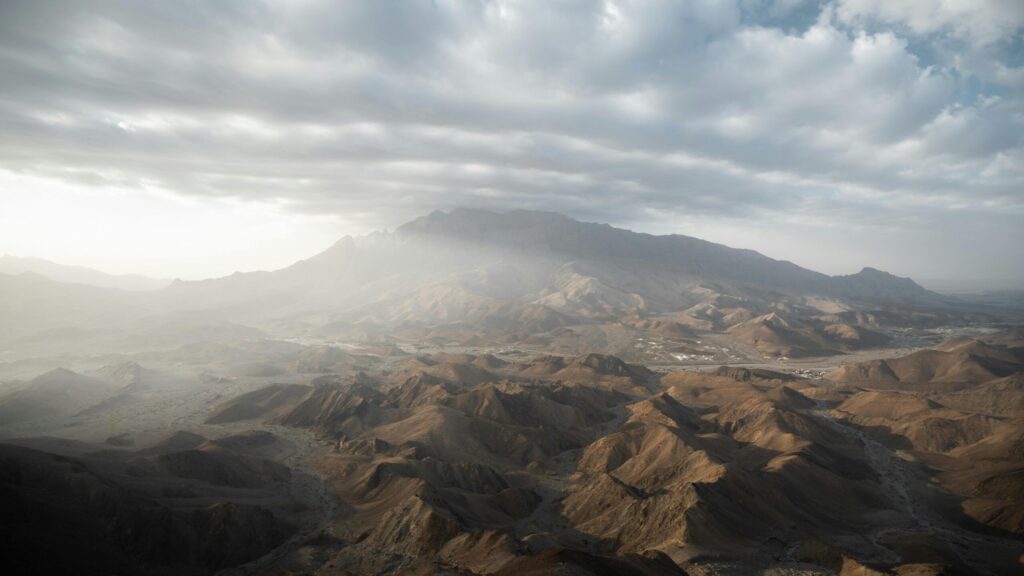
Aseer Highlands: Saudi Arabia’s Green Mountain Region
The Aseer Highlands rise in southwestern Saudi Arabia to over three thousand metres at Jabal Sawda — the highest point in the Kingdom. The region receives monsoon moisture from the Indian Ocean. Consequently, the landscape is terraced, agricultural and green in a way that appears entirely unlike the rest of Saudi Arabia. Temperatures at elevation are cool enough that the Aseer has historically been a summer retreat for Saudi families escaping the heat of the interior.
Almost nobody visits. For travellers willing to move beyond Saudi Arabia’s internationally recognised destinations, Aseer reveals a country within the country — ecologically richer, architecturally distinctive and almost entirely outside the current global travel conversation about the Kingdom.
The Landscape
The escarpment above Abha drops dramatically to the Tihamah coastal plain below — a descent of nearly two thousand metres within a horizontal distance of roughly fifty kilometres. From the Al Soudah viewpoint, the terrain falls away in layers of green, brown and eventually the pale haze of the Red Sea coast. Additionally, the cable car at Al Soudah — one of the longest in the Middle East — gives an aerial perspective on the escarpment that no road can replicate.
The terraced agriculture on the mountain slopes has been maintained for centuries. Stone walls built by hand across steep gradients retain soil and channel rainwater in a system that predates most comparable agricultural landscapes in Arabia. The visual effect — particularly in the green season between June and September — is extraordinary.
Rijal Almaa
Rijal Almaa is the most architecturally significant village in the Aseer region and one of the most remarkable traditional settlements in the Arabian Peninsula. Stone and mud-brick towers rise five and six storeys from the mountain terrain, decorated with distinctive coloured geometric patterns — the tiri design tradition specific to this region. The village is on the UNESCO World Heritage tentative list. However, unlike many heritage sites, it remains a living settlement rather than a preserved exhibit. People live here, and the architecture continues to be maintained by those who built it.
Wildlife
The Aseer Highlands carry ecological significance that extends beyond the landscape itself. The Arabian leopard — critically endangered with fewer than two hundred individuals remaining in the wild — has its primary Saudi habitat in these highlands. Sightings are rare but the population exists here, monitored by conservation teams operating in the region. Furthermore, hamadryas baboon troops are visible from the roads throughout the highlands — large groups moving through the escarpment in ways that are accessible to any traveller passing through.
The birdlife at this elevation is exceptional. Species endemic to the southwestern Arabian highlands appear here in numbers that attract serious birders from across the region. The Aseer National Park — the second largest in Saudi Arabia — protects a significant portion of this highland ecosystem.
When to Travel
Aseer divides into two distinct seasons. The green season between June and September brings monsoon moisture that transforms the landscape — terraces fill with crops, the hills turn visibly green and the light through cloud cover produces photographic conditions unlike anything in the rest of Arabia. However, rain can make some mountain roads unpredictable during this period. October through May delivers clear skies, comfortable temperatures and easier movement through the region. Both seasons have genuine merit and the choice depends on what the traveller most wants to see.
Combining Aseer with Other Arabia Destinations
Aseer works well as the southern extension of a longer Saudi Arabia journey. The Red Sea coast lies below the escarpment — the descent from the mountains to the Tihamah plain and then to the coast creates one of the strongest single-day geographical transitions in the Kingdom. Additionally, combining Aseer with AlUla and the Red Sea gives travellers the full range of Saudi Arabia’s environmental diversity — archaeology, marine, highland and desert — within a single coherent journey.
For Saudi Arabia journeys: Saudi Arabia
For the Red Sea: Red Sea
For the full Arabian Peninsula: Arabia by Oloi Shorua
If you are considering the Aseer Highlands as part of a private Arabian journey, we would be pleased to begin with a conversation.
Saudi Tourism — visitsaudi.com