
The Empty Quarter: Journeys Through the Rub’ al Khali
The Rub’ al Khali — the Empty Quarter — is the largest continuous sand desert on earth. At 650,000 square kilometres, it extends across Saudi Arabia into the UAE, Oman and Yemen. The scale is not something that can be adequately described in advance. It must be experienced to be understood.
Roads become isolated. Distances feel abstract. The silence is total in a way that urban environments make difficult to imagine. Furthermore, there are no reference points against which to measure direction or distance. The landscape reduces the traveller to a correct sense of proportion — a rare and genuinely valuable experience in modern travel.
The Desert
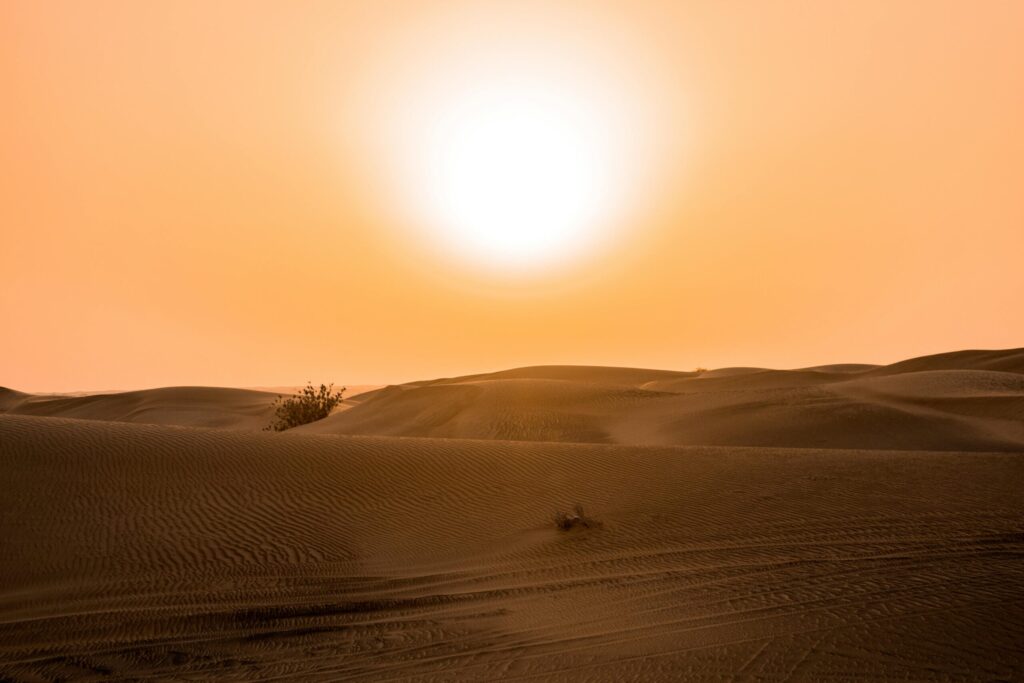
The Empty Quarter is not uniform. Dune systems rise to 250 metres in the central erg — among the tallest dunes on earth. Elsewhere, vast sabkha salt flats extend across the desert floor. Gravel plains and volcanic lava fields interrupt the sand in the peripheral zones. Additionally, the desert changes colour throughout the day — pale gold at dawn, deep amber at dusk, almost white in the overhead midday light. Each hour produces a different landscape from the same terrain.
The experience here is defined by absence rather than presence. There are no settlements, no roads, no power lines. Consequently, the silence has a physical quality — something registered rather than simply heard. For travellers who have spent their lives in cities, the Empty Quarter produces a reorientation that few other environments can replicate.
Thesiger and the Literature of the Desert
Wilfred Thesiger crossed the Empty Quarter twice — in 1946 and 1947 — with Bedu companions who had been moving through this terrain for generations. His account, Arabian Sands, remains the most honest writing about this landscape that exists. Reading it before travelling here changes what you see when you arrive. Thesiger understood the desert not as a spectacle but as a way of life — and his descriptions of the sand, the heat and the physical demands of desert travel give the Empty Quarter a human dimension that purely geographical writing cannot provide.
The Bedu relationship with the Rub’ al Khali spans millennia. Their ability to navigate, survive and find water within a landscape that appears entirely featureless to outsiders represents one of the most remarkable bodies of geographical knowledge in human history. Moving through the Empty Quarter with guides who carry even a fraction of that tradition changes the quality of the journey considerably.
How to Travel the Empty Quarter
The Empty Quarter requires proper logistical support. Convoys of vehicles, experienced desert drivers, navigation equipment and camp infrastructure are all necessary for any serious journey into the interior. However, the logistical demands are part of what makes arrival in the deep desert feel genuinely earned.
The strongest journeys move slowly — spending several nights within the desert rather than treating it as a day trip from a peripheral town. Camp life in the Empty Quarter, under a sky with no light pollution whatsoever, produces nights of a quality that travellers consistently describe as among the most memorable of their lives. Additionally, early morning drives before the heat builds give access to dune landscapes in the low light that no afternoon excursion can replicate.
When to Travel
November through February is the only comfortable window for extended Empty Quarter travel. Daytime temperatures drop to between twenty and thirty degrees — warm but manageable for overland movement and camp life. However, nights can be genuinely cold in December and January. Pack accordingly. March and October are shoulder months — warm but usable. April through September brings extreme heat. Surface sand temperatures can exceed eighty degrees Celsius in summer. Consequently, extended desert travel during those months is not advisable without specialist support and a clear understanding of the risks.
The Empty Quarter Within Arabia
The Empty Quarter combines most naturally with Oman — the movement from the Saudi interior into Oman’s Dhofar region or the Wahiba Sands creates a broader desert journey across multiple environments. Additionally, the UAE’s Liwa Oasis offers access to the northern edge of the Rub’ al Khali for travellers approaching from Abu Dhabi. Within Saudi Arabia, combining the Empty Quarter with AlUla and the Red Sea creates a journey of extraordinary geographical range — from ancient Nabataean archaeology to coral reef to the deepest desert on earth.
For Saudi Arabia journeys: Saudi Arabia
For Oman journeys: Oman
For the full Arabian Peninsula: Arabia by Oloi Shorua
If you are considering the Empty Quarter as part of a private Arabian journey, we would be pleased to begin with a conversation.
Saudi Tourism — visitsaudi.com
Visit Oman — visitoman.om