
Oman: Private Journeys Through Mountain, Desert and Coast
Oman is the most geographically varied country in the Arabian Peninsula. Within five days of travel, the terrain moves from fjord coastline to mountain canyon to dune desert. It then continues to a monsoon-green southern coast — each environment distinct, each requiring a different pace. The country has received serious travellers for decades. Its luxury hospitality circuit is established rather than emerging. What distinguishes Oman is the quality of the landscape itself. Equally important is the country’s deliberate restraint in how it has managed that development.
The Hajar Mountains, Wahiba Sands, Musandam and Dhofar are not interchangeable. Furthermore, no single Oman journey covers all of them well. The strongest approach is to choose two or three regions. Move through them slowly rather than attempting the whole country at speed.
Muscat
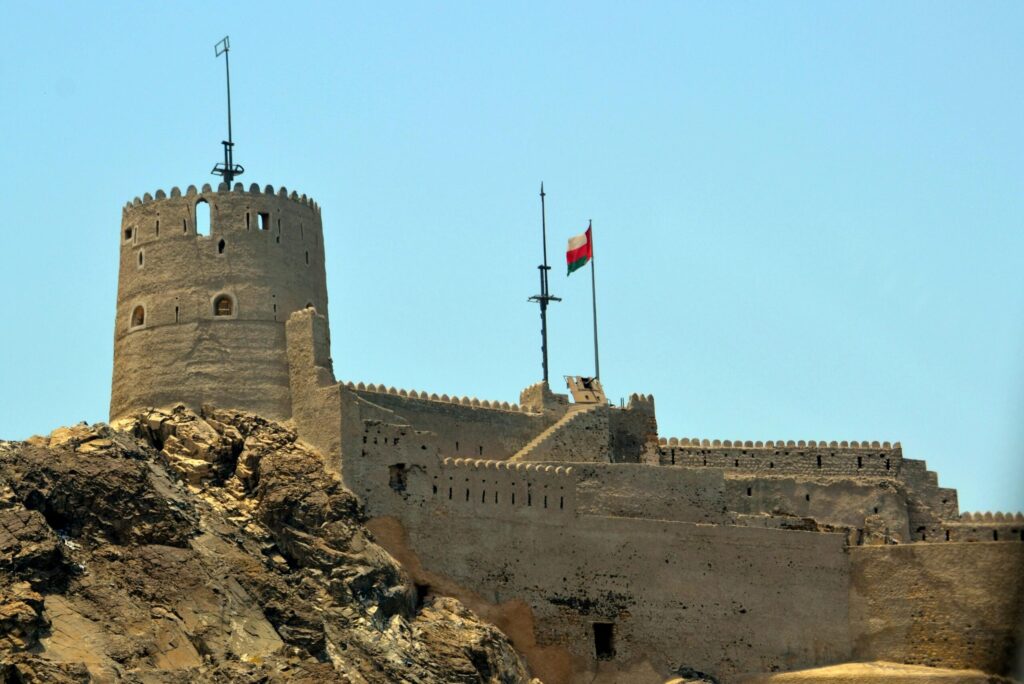
Muscat is the least developed capital in the Gulf and the more interesting for it. The city sits between the Hajar Mountains and the Gulf of Oman. This narrow coastal strip keeps the architecture modest. The surrounding terrain imposes a scale that Abu Dhabi and Dubai abandoned decades ago. The Muttrah Souq, the old corniche and the Al Bustan district carry a quality of age and continuity. This is rare in the modern Gulf. For most travellers, Muscat is an arrival and departure point rather than a destination. However, it rewards a day of careful attention before or after the journey inland.
Jabal Akhdar and the Hajar Mountains
The Hajar Mountains run five hundred kilometres through northern Oman. Jabal Akhdar — the Green Mountain — rises to nearly three thousand metres. Terraced rose gardens cultivated here for centuries still produce the rose water that Omani households use for hospitality. Jabal Shams is the highest point in the country. It drops into a canyon system of unexpected scale. The walls descend over a thousand metres to the wadi floor. The walking trails along the rim are consequently among the strongest in the Arabian Peninsula.
The hospitality on Jabal Akhdar has developed quickly but with restraint. Consequently, the mountain still feels like a landscape first and a destination second. That balance is worth protecting by choosing properties that sit within rather than above it.
Wahiba Sands
The Wahiba Sands — Sharqiyah Sands — cover twelve thousand square kilometres of dune desert in eastern Oman. The dunes are orange-red rather than the pale gold of the Empty Quarter. This produces stronger colour in the low morning and evening hours. The desert is accessible enough for multi-night stays without the expedition logistics that the Empty Quarter demands. Additionally, the Bedu communities still living within the Wahiba provide a human dimension that purely geographical deserts cannot.
Musandam
UAE territory separates Musandam from the rest of Oman. The Khassab fjords — khawr in Arabic — cut through mountain terrain that drops directly into the sea. The landscape resembles the Norwegian coast more than anything in Arabia. Dhow journeys pass beneath cliffs where dolphins follow the boats. The isolation from the urban Gulf feels complete. Yet Dubai is only ninety minutes away by road. Furthermore, Six Senses Zighy Bay sits within one of these inlets. Guests reach it by mountain road or by zipline descent from the ridge above.
Salalah and Southern Oman
Dhofar in southern Oman receives the tail of the Indian Ocean monsoon between June and September. During this period — the khareef — the landscape around Salalah turns visibly green. Mist covers the Dhofar hills. The frankincense trees that supplied the ancient incense routes still grow here — Boswellia sacra. This species is unique to this coastline. Moreover, UNESCO recognises the area as the Land of Frankincense. Salalah is not yet on the international luxury travel circuit in any meaningful way. Therefore, for travellers who seek destinations before discovery, Dhofar makes one of the most compelling arguments for an Oman journey.
Where to Stay in Oman
Oman has one of the strongest luxury hospitality circuits in the Arabian Peninsula. It has developed over twenty years with consistent attention to landscape integration.
Alila Jabal Akhdar sits on the rim of the canyon. Infinity pool views drop directly into the gorge below. Six Senses Zighy Bay occupies a Musandam fjord reachable by zipline or mountain road. It is consequently the most remote luxury property in northern Oman. The Chedi Muscat has defined quiet luxury in the Gulf since 2002. Long pools, restrained architecture and a stillness unusual for a capital city hotel set it apart. Desert Nights Camp in the Wahiba Sands brings proper camp luxury to the desert. Elevated platforms, strong guiding and genuine immersion in the dunes define the experience.
When to Travel
Oman divides by region and season. October through April covers the Hajar Mountains, Wahiba Sands, Musandam and Muscat. Temperatures are comfortable, skies are clear and conditions suit both walking and desert travel. June through September is when Salalah comes alive. The khareef transforms Dhofar. This period is the only time the frankincense landscape shows its full character. Consequently, the ideal journey focuses on the north in the cool season. Alternatively, add Salalah in summer — it requires a separate flight and a different register of travel entirely.
Combining Oman with Other Arabia Destinations
Oman combines naturally with the UAE. Musandam sits ninety minutes from Dubai and a northern circuit connects to Abu Dhabi easily. Additionally, the Empty Quarter spans the Oman-Saudi border. A journey through the Wahiba into the Rub’ al Khali therefore creates one of the strongest overland desert progressions in the region. Jordan, Saudi Arabia and Oman form the backbone of a comprehensive Arabian Peninsula journey. The circuit rewards travellers with the time to do it properly.
For the UAE: UAE
For Saudi Arabia: Saudi Arabia
For the full Arabian Peninsula: Arabia by Oloi Shorua
If you are considering Oman as part of a private Arabian journey, we would be pleased to begin with a conversation.
Visit Oman — visitoman.om