
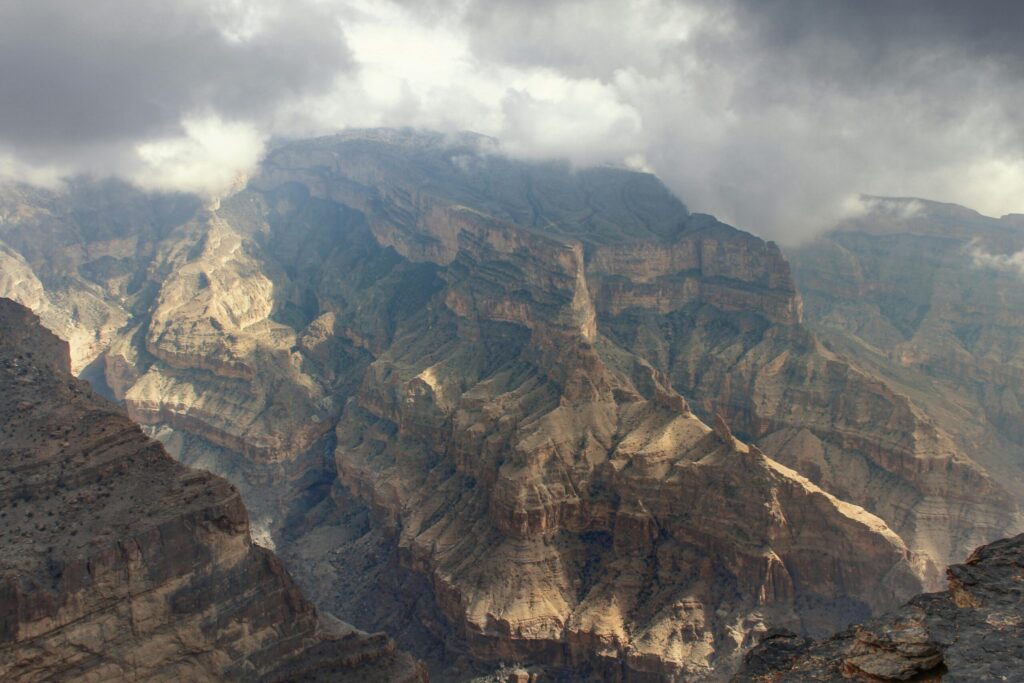
Arabian Journeys Jabal Shams
Jabal Shams unfolds through canyon landscapes, high mountain roads and some of the most dramatic elevation anywhere in the Arabian Peninsula. Rising within the Hajar Mountains of northern Oman, the region reveals a quieter and more rugged side of Arabia shaped by cliffs, vast escarpments and the immense scale of the surrounding terrain.
For travellers moving through Oman, Jabal Shams introduces a very different rhythm of travel from the desert and coastline elsewhere across the country. Roads climb gradually into elevated mountain landscapes where villages, rocky plateaus and deep canyon systems create journeys shaped by geography and movement rather than fixed destinations alone.
At Oloi Shorua, we approach Jabal Shams through pacing, landscape and environmental continuity rather than fixed itineraries. Every journey is shaped around season, terrain and the natural rhythm of travel through the mountains themselves.
Understanding Jabal Shams Through Landscape
Jabal Shams is experienced through elevation and scale. Mountain roads rise steadily into cooler air while cliffs and canyon systems reveal vast open views across the surrounding highlands.
The region carries a stronger sense of ruggedness than many other parts of Oman. Rocky terrain, shifting mountain light and open escarpments create a landscape that feels both isolated and expansive at the same time.
As a result, journeys through Jabal Shams are often defined less by activity and more by atmosphere, silence and the experience of movement through the mountains.
The Grand Canyon of Arabia
Jabal Shams is often associated with Oman’s immense canyon landscapes sometimes referred to as the “Grand Canyon of Arabia.” Deep gorges cut through the mountains while the escarpments reveal dramatic vertical drops across the surrounding terrain.
The scale of the landscape changes constantly with light throughout the day. Early mornings soften the cliffs while evenings create long shadows across the canyon walls and elevated plateaus.
For many travellers, the emotional impact of Jabal Shams comes directly from this relationship between scale, silence and exposure within the mountain environment.
Mountain Roads and Elevated Villages
The roads leading into Jabal Shams form an important part of the experience itself. Gradual ascents through rocky valleys and mountain corridors create strong transitions between the plains below and the elevated landscapes above.
Smaller settlements and traditional villages remain closely connected to the surrounding terrain while the atmosphere of the mountains encourages a slower pace of movement across the region.
Over time, these shifts in elevation and geography become central to understanding the wider landscape of northern Oman.
Slower Mountain Travel
Jabal Shams rewards slower pacing. Rather than moving quickly between locations, the region works best through quieter stays, time spent within the landscape and gradual exploration of the surrounding mountain environment.
Lower temperatures, dramatic canyon views and the openness of the escarpments create a calmer and more reflective atmosphere than the urban Gulf or the desert regions elsewhere across Arabia.
For travellers seeking stillness and environmental immersion, Jabal Shams remains one of the strongest mountain experiences anywhere in the Arabian Peninsula.
The Future of Travel in Oman’s Mountains
Across Arabia, travellers increasingly seek quieter and more landscape-led forms of travel centred around atmosphere, geography and environmental continuity rather than spectacle alone.
Jabal Shams naturally reflects this shift. Its strength lies not in development or scale of infrastructure, but in the integrity of the landscape itself.
As travel across Oman continues to evolve, the mountain regions increasingly provide balance to the coastline and desert elsewhere in the country while reinforcing Oman’s reputation for slower and more grounded travel experiences.
How We Design Journeys Through Jabal Shams
Every journey begins with a conversation. From there, we shape how movement through the mountains should unfold naturally — when to travel, how long to remain in the region and how Jabal Shams should connect with wider journeys across Oman.
Rather than relying on fixed itineraries, we design every journey individually around terrain, weather, pace and personal interests. Some travellers focus entirely on canyon landscapes and mountain travel while others combine Jabal Shams with desert regions, coastline and wider Arabian Peninsula journeys.
Our role is to create continuity and rhythm throughout the experience while allowing the landscape itself to define the pace of travel.
Journeys Across Jabal Shams
- Canyon and mountain journeys
- Landscape and photography-focused travel
- Slower mountain retreats
- Elevated overland exploration
- Combined mountain and desert journeys
- Multi-region Oman travel
- Wider Arabian Peninsula journeys
These are not predefined routes. Instead, they act as starting points refined individually through discussion and planning.
Jabal Shams Within Oman
Jabal Shams combines naturally with wider journeys across northern Oman. The movement between the Hajar Mountains, Jabal Akhdar, Wahiba Sands and the coastline near Muscat creates broader regional journeys shaped by geography and environmental contrast.
Over time, these combinations allow travellers to experience multiple dimensions of Oman through shifting terrain, climate and atmosphere across the country itself.
Many journeys combine Jabal Shams with:
- Oman
- Jabal Akhdar
- Wahiba Sands
- Muscat
Begin Your Journey Through Jabal Shams
Our work across Jabal Shams continues to develop through regional partnerships, specialist operators and guiding teams across northern Oman.
If you are considering journeys through Jabal Shams and prefer a quieter, more informed and landscape-led approach to travel, we would be pleased to begin with a conversation.
Oman — Visit Oman
Jabal Shams — Explore Jabal Shams