
Arabian Journeys Jabal Akhdar
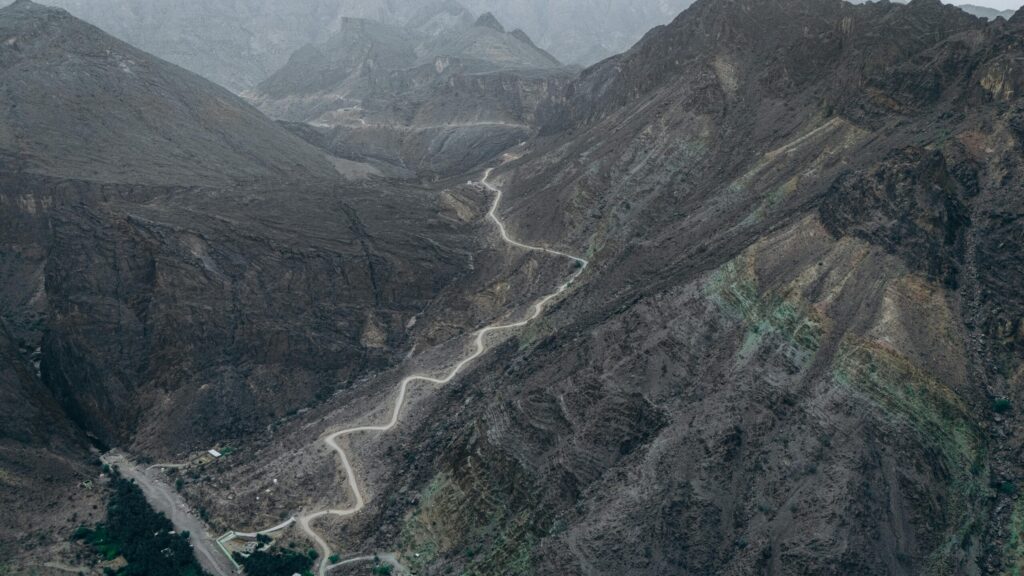
Jabal Akhdar unfolds through elevated plateaus, canyon landscapes and mountain roads that rise high above the desert plains of northern Oman. Set within the Hajar Mountains, the region offers one of the most dramatic geographical contrasts anywhere in the Arabian Peninsula.
For travellers moving through Oman, Jabal Akhdar introduces a slower and more atmospheric rhythm of travel shaped by altitude, cooler temperatures and the changing light across the mountain landscape. Terraced villages, deep valleys and winding roads create journeys that feel grounded in terrain and movement rather than fixed destinations alone.
At Oloi Shorua, we approach Jabal Akhdar through pacing, geography and environmental continuity rather than fixed itineraries. Every journey is shaped around season, landscape and the natural rhythm of travel through the mountains themselves.
Understanding Jabal Akhdar Through Landscape
Jabal Akhdar is experienced through elevation and transition. Roads climb gradually from the desert plains into cooler mountain terrain where deep canyons, terraced agriculture and open plateaus create an entirely different environment from the coastline and desert regions elsewhere in Oman.
The landscape changes constantly throughout the day. Early morning light softens the mountain valleys while evenings bring long shadows across the surrounding escarpments.
As a result, journeys through Jabal Akhdar often feel quieter, slower and more connected to the geography itself.
The Hajar Mountains
The Hajar Mountains form one of the defining geographical features of eastern Arabia. Across Jabal Akhdar, the mountain range creates dramatic vertical landscapes shaped by cliffs, elevated valleys and shifting terrain.
Unlike the open desert regions further inland, the mountains create a more enclosed and layered environment where roads and villages remain closely integrated into the natural landscape.
For travellers exploring the Arabian Peninsula, the Hajar range provides important geographical contrast within wider journeys across Oman and the UAE.
Villages and Terraced Landscapes
Throughout the mountain region, villages remain closely connected to the surrounding terrain through traditional settlement patterns and terraced agriculture built gradually into the slopes.
These landscapes create continuity between architecture, agriculture and geography that still shapes much of the region today.
Rather than dominating the environment around them, many villages feel integrated directly into the mountains themselves. As a result, travel through the region often feels grounded in atmosphere and continuity rather than large-scale infrastructure.
Mountain Hospitality and Slower Travel
Jabal Akhdar increasingly attracts travellers seeking quieter and more landscape-led experiences across the Arabian Peninsula. Mountain lodges and lower-density hospitality now shape a slower form of travel focused on scenery, stillness and environmental immersion.
Rather than constant movement, the region rewards time spent within the landscape itself. Cooler temperatures, canyon views and changing mountain light all contribute to a more measured pace of travel.
For many travellers, Jabal Akhdar becomes one of the most restorative parts of wider journeys through Oman.
The Future of Travel in Oman’s Highlands
Across Arabia, travellers increasingly seek destinations shaped by geography, atmosphere and lower-density hospitality rather than spectacle alone. Jabal Akhdar naturally supports this shift through its elevation, climate and environmental contrast within the wider peninsula.
As travel across Oman continues to evolve, the mountain regions increasingly provide balance to the desert and coastline elsewhere in the country.
For travellers seeking quieter landscapes and slower movement through the Arabian Peninsula, Jabal Akhdar remains one of the strongest mountain environments anywhere in the region.
How We Design Journeys Through Jabal Akhdar
Every journey begins with a conversation. From there, we shape how movement through the mountains should unfold naturally — when to travel, how long to remain in the region and how the mountain landscapes should connect with wider journeys across Oman.
Rather than relying on fixed itineraries, we design every journey individually around terrain, season, pace and personal interests. Some travellers focus entirely on mountain scenery and slower retreats while others combine Jabal Akhdar with desert regions, coastline and wider Arabian Peninsula travel.
Our role is to create continuity and rhythm throughout the experience while allowing the landscape itself to define the pace of travel.
Journeys Across Jabal Akhdar
- Mountain and canyon journeys
- Landscape and photography-focused travel
- Slower mountain retreats
- Village and cultural landscape exploration
- Combined mountain and desert journeys
- Multi-region Oman travel
- Wider Arabian Peninsula journeys
These are not predefined routes. Instead, they act as starting points refined individually through discussion and planning.
Jabal Akhdar Within Oman
Jabal Akhdar combines naturally with wider journeys across Oman. The movement between the Hajar Mountains, Wahiba Sands and the coastline of Muscat creates broader regional journeys shaped by geography and environmental contrast.
Over time, these combinations allow travellers to experience multiple dimensions of Oman through shifting terrain, climate and atmosphere across the country itself.
Many journeys combine Jabal Akhdar with:
- Oman
- Muscat
- Wahiba Sands
- Musandam
Begin Your Journey Through Jabal Akhdar
Our work across Jabal Akhdar continues to develop through regional partnerships, specialist operators and guiding teams across northern Oman.
If you are considering journeys through Jabal Akhdar and prefer a quieter, more informed and landscape-led approach to travel, we would be pleased to begin with a conversation.
Oman — Visit Oman
Jabal Akhdar — Explore Jabal Akhdar